
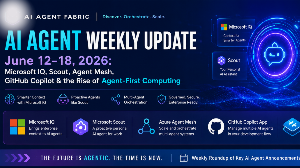


An Overview
The AI agent space isn’t just evolving, it’s accelerating in very real, practical ways. This week’s developments show a clear pattern: agents are moving beyond experiments and into decision-making systems, enterprise workflows, and even social environments.
Here’s a breakdown of 10 key AI agent developments from this week, explained in a clear, human tone with links if you want to explore further.
1. AI agents reach 66% Human-level task performance
One of the biggest signals this week came from new benchmarks showing AI agents reaching 66% success on real-world computer tasks, a massive jump from just 12% earlier.
This isn’t just a number, it means agents are now capable of navigating software and completing tasks in ways that are starting to resemble real human workflows. We’re getting closer to agents that can actually “do the work,” not just assist.
2. Microsoft moves toward always-on, secure AI agents
Microsoft is reportedly working on a more advanced, secure version of agentic systems within Copilot designed to be proactive, role-based, and always running in the background.
Instead of waiting for prompts, these agents could anticipate tasks, manage workflows, and operate with defined permissions much closer to how employees function inside organizations.
3. OpenAI Shifts toward full agent ecosystem strategy
An internal update from OpenAI highlights a major shift—from standalone tools to a complete agent ecosystem spanning models, deployment, and enterprise integration.
The focus is no longer just better models, but how those models are deployed as agents inside real business systems.
4. AI agents enter boardrooms for decision support
In a notable real-world use case, a major bank has introduced an AI-powered “boardroom agent” to support executive decision-making.
These agents analyze data, highlight risks, and even challenge biases, showing how AI is starting to influence high-level strategic decisions, not just operational tasks.
5. Central Banks begin testing risks of ai agents
The Bank of England is actively studying how AI agents could impact financial systems, especially in scenarios where multiple agents act in similar ways and amplify market movements.
This highlights a growing concern: as agents become autonomous, their collective behavior could introduce new systemic risks.
6. AI agents move into social and personal use cases
A new concept called “Pixel Societies” explores how AI agents can interact socially—forming relationships, recommending matches, and simulating personalities.
While still experimental, this signals a future where agents don’t just work for us—they may also interact on our behalf.
7. Agentic AI adoption is exploding across enterprises
Recent insights show that 65% of organizations are already experimenting with AI agents, though only a fraction have scaled them successfully.
The challenge is no longer building agents, it’s deploying them reliably in production environments.
8. Multi-Agent systems become the default direction
A growing trend across research and enterprise systems is the move toward multi-agent architectures, where different agents handle planning, execution, and validation.
This approach improves reliability and scalability, but also introduces new challenges around coordination and orchestration.
8.AI agents shift from research to production systems
Developers and companies are increasingly treating AI agents as production infrastructure, not experimental tools.
The focus is shifting toward stability, edge cases, and real-world deployment, where the real value of agents is now being tested.
10. Agent infrastructure becomes the real battleground
Across all announcements, one theme stands out: the real competition is shifting toward infrastructure—security, orchestration, and control layers.
Whether it’s Microsoft building secure agents or central banks studying risks, it’s clear that the next phase of AI won’t be defined by models alone, but by how agents are managed and deployed.
Final Take
If you step back, this week tells a very clear story:


