Agentic AI represents the next major evolution in artificial intelligence, shifting from static prompt-response systems to active, autonomous problem-solving entities.
Within a hierarchical agent system, Agentic AI serves as a sophisticated tool dynamically controlled by a Parent Agent (often a powerful LLM). This architecture facilitates:
Structured Delegation: The parent LLM can intelligently break down complex goals and assign specific tasks to specialized sub-agents.
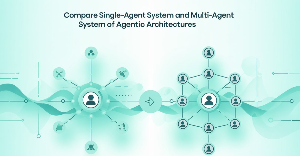
Intelligent Collaboration: It enables seamless, structured communication and collaboration among multiple agents to efficiently achieve the overarching objective.
Agentic AI refers to a new generation of AI systems that possess agency, the ability to act autonomously and proactively to achieve a goal. It signifies a major shift from passive, reactive models to active, autonomous problem-solvers.
Unlike traditional AI models that only respond when prompted, Agentic AI operates like a digital worker by taking the initiative.
An Agentic AI entity is defined by its ability to execute a full cognitive loop:
Goal Understanding: Translating high-level, complex objectives into actionable direction.
Planning & Reasoning: Devising multi-step plans and making logical decisions to achieve the goal.
Autonomous Action: Executing tasks by interacting with tools and external environments without constant human supervision.
Environmental Learning: Continuously learning from feedback, outcomes, and the environmental signals to enhance future performance.
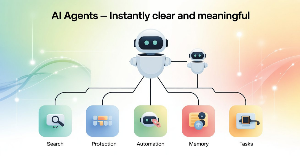
A crucial innovation in designing highly capable AI systems is the Hierarchical Agent Model, which organizes intelligence into layers of control and specialization.
This structure defines the Parent Agent as the supervisor, utilizing Agentic AI components as its tools for execution:
Parent Agent LLM (Supervisor)
Specialist Agents:
Specialist Agent 1 (Research)
Specialist Agent 2 (Coding)
Specialist Agent 3 (Decision-Making)
Tools & APIs (Agentic AI components)
Parent Agent LLM: Acts as the main controller or "brain," responsible for high-level reasoning, planning, and task decomposition.
Child Specialist Agents: Each child agent possesses expertise in a narrow domain (e.g., coding, data analysis) and executes the delegated sub-tasks.
Agentic AI Components: These are the foundational tools, API calls, code interpreters, or database interfaces—used by the child agents to perform physical skills and actions in the external world.
Key Principle: Agentic AI is fundamentally a tool used within this hierarchical structure, directed and coordinated by the strategic oversight of the Parent Agent LLM.
Why Hierarchical Agent Systems Matter
The hierarchical architecture represents a significant advancement, ensuring Agentic AI is safe, scalable, and efficient by systematically managing complexity. This model mirrors successful human organizations, where a leader sets strategy, and specialized teams execute the work.
Each individual agent can excel at one focused skill (e.g., coding, research), ensuring high-quality output for delegated sub-tasks.
Monitoring & Safety
The Parent LLM acts as a supervisor, constantly keeping child agents aligned with the high-level goals and safety protocols, reducing the risk of unintended actions.
Faster Execution
Complex tasks can be broken down, and sub-tasks can run in parallel by different agents, dramatically reducing overall completion time.
Expandability
The system is highly flexible; new specialized agents or tools/APIs can be added easily without requiring a redesign of the entire control structure.
Agentic AI is a practical reality today, already tackling complicated, fragmented work and converting it into smooth, end-to-end automation pipelines..
Software Development: Multi-Agent Systems support autonomous development as specialized agents collaboratively manage all phases of the application lifecycle, from requirement gathering and design to implementation, testing, and deployment.
Business Automation: Agents serve as digital staff that manage core workflows, handling tasks like triaging emails, scheduling complex meetings across time zones, and executing routine yet time-consuming business processes.
Scientific Research: Multi-agent collaboration accelerates discovery. Agents work together to perform literature reviews, generate novel hypotheses, design complex experiments, and analyze large-scale simulation data (e.g., in materials science or chemistry).
Robotics & Logistics: In dynamic physical environments, Agentic AI enables autonomous coordination. This includes swarm intelligence for distributed drone operations or multi-agent systems optimizing complex logistics, traffic flow, and supply chain responses in real-time.
This includes swarm intelligence for managing drone fleets and multi-agent systems that optimize logistics, traffic, and supply chain decisions in real time.
Agentic AI is rapidly transforming into:
An Autonomous Worker: AI systems capable of fully owning and executing complex, multi-step tasks without constant human intervention.
A Collaborative Teammate: Agents that can effectively communicate, negotiate, and work alongside both human teams and other AI systems.
A Digital Ecosystem: A sophisticated, autonomous network of specialized agents and tools that can be flexibly combined to tackle novel challenges.
This growing momentum cements Agentic AI as the fundamental backbone of self-directing intelligent automation across all industries.
Join AIAgentFabric today to discover, register, and market your AIAgents.