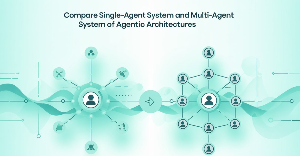
As Agentic AI advances, there is a distinct evolution from conventional models to sophisticated systems capable of reasoning, planning, and autonomous action.
In the world of Agentic Architectures, two core models are commonly used: Single-Agent Systems and Multi-Agent Systems (MAS).
Understanding the fundamental distinctions between these two approaches is crucial for developers when selecting the optimal architecture for diverse real-world applications.
A Single-Agent System is an autonomous AI entity designed to perform tasks independently. It operates as a solitary, self-contained unit, executing the entire task lifecycle.
Key Characteristics:
Centralized Control: Features one centralized decision-making unit responsible for all operations.
Autonomous Pipeline: Handles the complete perception $\rightarrow$ reasoning $\rightarrow$ action pipeline on its own.
Problem Scope: Typically operates effectively within well-defined, limited problem spaces.
Development: Generally easier to develop, train, and maintain due to its simpler architecture.
Example Use Cases
Personal AI assistants (e.g., scheduling, basic information retrieval).
Route navigation systems (calculating optimal paths based on current data).
Automated chat/support agents (handling standard customer inquiries).
A Multi-Agent System (MAS) comprises multiple autonomous agents that interact, either cooperatively or competitively, to achieve a common goal or solve highly complex problems.
Key Characteristics
Decentralized Control: Relies on decentralized coordination and communication between independent agents.
Specialized Roles: Agents can possess specialized roles and knowledge, contributing distinct expertise.
Interaction: Supports complex behaviors like collaboration, negotiation, and dynamic task distribution.
Scalability: Offers high scalability and robustness, making it ideal for large, dynamic environments.
Example Use Cases
Smart cities and IoT automation (traffic control, energy grid management).
Distributed robotics (e.g., swarms, coordinated drone operations).
Financial trading and supply-chain optimization (real-time market response and logistics).
Single-Agent System:
Control: Centralized. One unit is responsible for all decisions and execution.
Complexity: Low. The architecture is simpler, making development and maintenance straightforward.
Multi-Agent System (MAS):
Control: Distributed. Decision-making is spread across multiple, independent agents.
Complexity: High. Requires complex mechanisms for communication, coordination, and negotiation among agents.
Single-Agent System:
Scalability: Limited. Performance often degrades significantly when the task becomes too large or complex for the single unit.
Task Suitability: Best for narrow, predictable tasks within a well-defined domain (e.g., a simple chatbot).
Multi-Agent System (MAS):
Scalability: Highly Scalable. New agents can be added to handle increased load or complexity without redesigning the core system.
Task Suitability: Ideal for large-scale or highly dynamic tasks where parallel processing and diverse expertise are required (e.g., smart grid management).
3. Decision-Making and Resilience
Single-Agent System:
Decision-Making: Individual. Decisions are based solely on its own internal state, perception, and reasoning.
Fault Tolerance: Low. It is a single point of failure; if the agent fails, the entire system stops.
Communication: Minimal (only internal processing).
Multi-Agent System (MAS):
Decision-Making: Collaborative. Decisions often require interaction, negotiation, or consensus among the agents.
Fault Tolerance: High. Due to redundancy, if one agent fails, others can often take over or reroute the task.
Communication: High (requires robust protocols for agent-to-agent talk).
The choice between a Single-Agent System and a Multi-Agent System depends entirely on the nature of the task and the operational environment.
Task Simplicity: The tasks are simple, narrow, and predictable, requiring limited internal complexity.
Speed is Critical: Real-time decisions are crucial, and the overhead of agent communication must be avoided.
Resource Constraints: There are budget or compute restrictions, as single agents are less expensive to build and run.
Environment Stability: The operating environment is static or changes slowly.
Distributed Intelligence: Tasks require parallelism, distribution, or diverse intelligence across specialized components.
Environmental Complexity: The environment is complex, dynamic, and rapidly changing, requiring adaptable solutions.
Enhanced Performance: Collaboration, negotiation, or specialization between agents significantly improves overall efficiency, robustness, or accuracy.
High Resilience: Fault tolerance is a non-negotiable requirement.
The trajectory of Agentic AI is moving beyond the binary choice of single or multi-agent designs, pointing toward sophisticated Hybrid Agentic Systems.
This emerging architecture seeks to capture the best of both worlds:
Simplicity & Speed: Retaining the simplicity and efficiency of a single, expert agent for core, critical tasks.
Collective Intelligence: Integrating this expert with the collective intelligence, robustness, and scalability offered by multi-agent coordination for complex, distributed challenges.
Single-agent architectures and multi-agent systems (MAS) represent foundational models at the heart of contemporary Agentic AI development.
Single-Agent Systems excel in simplicity, speed, and resource efficiency for narrow, predictable tasks.
Multi-agent systems dominate in adaptability, high fault tolerance, and large-scale, distributed intelligence for complex environments.
The ultimate success of an Agentic AI application hinges on choosing the right architecture that aligns optimally with the specific problem's constraints, complexity, and performance goals.
Join AIAgentFabric today to discover, register, and market your AIAgents.