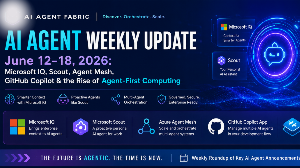
An Overview
This week in AI agents wasn’t just about new models it was about real deployment, orchestration, and enterprise execution.
Across the industry, companies are moving beyond simple copilots and building systems that can coordinate workflows, interact with tools, and operate autonomously inside business environments. From OpenAI and Microsoft to enterprise infrastructure providers, the focus is rapidly shifting toward scalable agent ecosystems.
Here are 10 major AI agent developments from this week, explained in a clear, human tone—with direct links for deeper reading.
1. OpenAI expands enterprise AI agent strategy
OpenAI significantly expanded its enterprise AI strategy this week, focusing on agents capable of handling workflows across customer support, operations, and internal productivity systems.
The company emphasized that the future of AI is not just smarter chatbots, but systems that can reason, plan, and execute tasks autonomously across enterprise environments. This reflects a broader industry trend toward operational AI rather than isolated conversational tools.
2. Microsoft pushes ai agents deeper into workflow update
Microsoft introduced new Copilot capabilities focused on autonomous workflow execution inside Microsoft 365. The latest updates allow AI agents to coordinate meetings, summarize projects, generate reports, and trigger actions across apps.
What stands out is how AI agents are gradually becoming “background workers” inside enterprise software handling operational tasks continuously instead of waiting for prompts.
3. Google Expands multi-agent infrastructure for enterprises
Google Cloud announced new infrastructure designed specifically for multi-agent orchestration and enterprise deployment. The platform focuses on secure coordination between specialized agents handling planning, execution, and monitoring tasks.
This highlights how orchestration is becoming one of the most important layers in the AI stack. Companies are realizing that scaling agents requires much more than just powerful models.
4. Anthropic highlights safety risks in autonomous agents
Anthropic published new research discussing the growing safety challenges around autonomous AI agents. The company highlighted issues involving tool misuse, uncontrolled execution loops, and long-running autonomous tasks.
As agents become more capable, governance and monitoring are becoming just as important as performance. This week reinforced that safety infrastructure will be critical for enterprise adoption.
5. Salesforce expands ai agent automation across CRM
Salesforce expanded its AI agent ecosystem through new “Agentforce” capabilities designed for customer service, sales, and workflow automation.
The company’s focus is shifting toward agents that can independently manage customer interactions, update CRM systems, and coordinate actions across enterprise platforms all with minimal human intervention.
6. nvidia continues building open agent ecosystems
NVIDIA introduced additional tooling for AI agent orchestration, deployment, and optimization. Its ecosystem increasingly supports developers building long-running autonomous systems rather than simple AI applications.
NVIDIA’s role is evolving from GPU provider to foundational infrastructure layer for the growing agent economy.
7. MCP adoption accelerates across enterprise platforms
Model Context Protocol (MCP) continued gaining momentum this week as more enterprise vendors adopted it for secure tool integration and orchestration.
MCP is quickly becoming one of the most important standards for AI agents because it allows systems to interact with tools, permissions, and enterprise services in a structured and secure way.
8. AI coding agents continues rapid growth
AI coding agents remain one of the fastest-growing areas in agentic AI. New systems are now capable of planning software architecture, debugging issues, testing code, and even deploying applications automatically.
This week’s updates suggest software development may become one of the first industries heavily transformed by autonomous AI execution systems.
9. Enterprises focus on observability & Agent Governanace
A major theme this week was observability the ability to monitor, audit, and control AI agent behavior inside enterprise environments.
As organizations deploy larger numbers of agents, they are increasingly prioritizing governance systems that provide transparency into decisions, actions, and execution flows.
10. Multi-agent systems become the default architecture
Across research and enterprise platforms, multi-agent systems are rapidly emerging as the preferred architecture for scalable AI systems.
Instead of relying on one large model, organizations are designing ecosystems of specialized agents that collaborate on planning, execution, validation, and monitoring tasks independently.
This approach is proving more scalable, modular, and reliable for complex workflows.
Final takeaway
This week’s developments reinforce a major shift happening across the AI industry:
1.AI agents are evolving from assistants into operational systems
2.Multi-agent orchestration is becoming core infrastructure
3.Governance, observability, and security are now essential priorities
4.Enterprises are deploying AI agents into real workflows at scale
The industry is no longer asking:
“Can AI generate useful responses?”
It’s asking:
“Can AI systems autonomously execute work safely, reliably, and at scale?”
And that transition is shaping the next era of enterprise software.


