An Overview
The AI agent industry continues to move at an extraordinary pace, but this week felt different.
The conversation is no longer centered on model benchmarks alone. Instead, the biggest announcements focused on the infrastructure, context, orchestration, and platforms needed to make AI agents truly useful in real-world environments.
From Microsoft's ambitious agent ecosystem to GitHub's agent-native development experience and growing enterprise investment in agent orchestration, the industry is rapidly building the foundation for a future where autonomous agents become a normal part of everyday work.
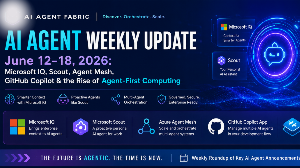
Here are the ten most important developments from the week of June 12–18, 2026.
1. Microsoft IQ brings context-aware intelligence to AI agents
One of the most important themes this week was Microsoft's continued push around Microsoft IQ, a new context layer designed to help AI agents understand enterprise data, organizational relationships, and workplace signals. Microsoft believes that agents are only as effective as the information available to them, and IQ aims to solve the context problem that has limited many AI deployments.
Instead of relying solely on model training data, Microsoft IQ connects agents directly to documents, business applications, organizational knowledge, and web resources. The result is AI systems that can make better decisions, provide more relevant responses, and operate with a stronger understanding of their environment.
2. Microsoft scout introduces a new personal ai agent
Microsoft also unveiled Scout, a new personal AI agent powered by its internally developed reasoning model MAI-Thinking-1. Scout is designed to help users manage schedules, prepare for meetings, summarize information, and proactively assist with work-related tasks.
What makes Scout noteworthy is Microsoft's effort to move beyond reactive assistants. Instead of waiting for prompts, Scout is designed to anticipate needs and support users across their daily workflows, reflecting the industry's broader shift toward proactive AI agents.
3. Azure agent mesh expands multi-agent coordination
Multi-agent systems continued to gain momentum this week through Microsoft's Azure Agent Mesh. The platform enables organizations to coordinate multiple specialized AI agents across cloud environments, enterprise systems, and devices.
As companies deploy planning agents, execution agents, monitoring agents, and validation agents, orchestration becomes essential. Azure Agent Mesh is designed to provide the coordination layer required to make large-scale multi-agent systems practical in enterprise environments.
4. Github copilot evolves into an agent-native development platform
GitHub introduced a new Copilot desktop application that functions as a centralized control center for managing multiple AI coding agents. Developers can now coordinate several autonomous workflows simultaneously while maintaining oversight of execution.
This marks an important shift in software development. AI is no longer just helping developers write code—it is increasingly participating in planning, implementation, debugging, testing, and workflow execution. The role of developers is gradually evolving toward supervising intelligent systems rather than manually performing every task.
5. Github opens the door to agent apps
GitHub expanded its ecosystem with the introduction of Agent Apps, allowing third-party AI agents to integrate directly into GitHub workflows through the GitHub Marketplace.
This announcement reflects a growing trend across the industry: platforms are no longer focused on a single assistant. Instead, they are becoming marketplaces and ecosystems where specialized agents can collaborate, compete, and deliver domain-specific capabilities to users.
6. Project solara signals the arrival of agent-first devices
Microsoft's Project Solara continues to generate significant attention. The platform introduces a vision for agent-first devices where AI agents replace traditional applications as the primary interface between users and technology.
Rather than launching apps and navigating menus, users interact with intelligent agents that understand requests, coordinate services, and complete tasks across multiple systems. This represents one of the most ambitious attempts yet to redefine personal and enterprise computing around agentic AI.
7. web iq gives ai agents better access to online knowledge
Microsoft introduced Web IQ, a new set of APIs that allows AI agents to retrieve grounded information directly from Bing's search infrastructure. Instead of processing entire webpages, agents receive selected passages and structured evidence.
The goal is to reduce hallucinations, improve answer quality, and lower operating costs. As agents become responsible for more important tasks, reliable access to trustworthy information is becoming a critical requirement.
8. Windows continues its transformation into an ai agent platform
Microsoft continues positioning Windows as a platform for AI agents rather than simply an operating system for applications. New frameworks and infrastructure allow agents to operate within secure sandboxes while interacting safely with files, apps, and enterprise systems.
This strategy suggests Microsoft sees agents becoming a fundamental unit of computing, similar to how applications defined previous generations of software.
9. Agent governance and security move to center stage
As AI agents gain greater autonomy, governance and security are becoming major priorities. Microsoft highlighted new sandboxing capabilities and oversight mechanisms designed to help organizations understand and control agent behavior.
This reflects a broader trend across the industry. Enterprises are increasingly asking not only what agents can do, but how their actions can be monitored, audited, and governed responsibly.
10. the industry is building the agentic technology stack
Perhaps the biggest takeaway from this week is that the agent ecosystem is starting to resemble a complete technology stack. Context layers, orchestration frameworks, governance systems, communication protocols, marketplaces, and execution platforms are all emerging simultaneously.
The future of AI will not be defined solely by better models. It will be defined by the infrastructure that allows thousands of agents to work together safely, intelligently, and at scale.
Final Takeaway
This week reinforced a major shift happening across the AI industry.
The conversation is moving away from:
"Which model is smartest?"
And toward:
"How do we build, orchestrate, govern, and scale autonomous agents?"
Microsoft's IQ, Scout, Agent Mesh, Web IQ, Project Solara, and GitHub's expanding agent ecosystem all point toward the same future: AI agents are becoming a new computing layer.
The next phase of AI won't be defined by a single model.
It will be defined by how effectively agents understand context, collaborate with other agents, and execute work across real-world systems.


