An Overview
The AI agent ecosystem continued to gather momentum this week as technology companies shifted their focus from building smarter models to creating more capable autonomous systems.
The biggest announcements weren't simply about new AI features—they were about giving agents better memory, stronger orchestration, improved developer tooling, and deeper enterprise integration. Across Microsoft, OpenAI, NVIDIA, GitHub, and the growing MCP ecosystem, one message became increasingly clear: AI agents are becoming the next software platform.
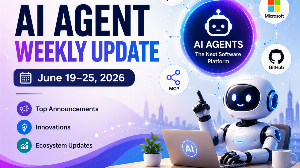
Here are ten of the biggest developments from June 19–25, 2026.
1. OpenAI expands chatgpt agent capabilities for enterprise workflows
OpenAI continued expanding ChatGPT's agent capabilities with stronger support for enterprise workflows, allowing agents to better plan tasks, maintain context across conversations, and interact with business tools. The company is increasingly positioning ChatGPT as an intelligent digital coworker rather than a conversational assistant.
The latest improvements demonstrate OpenAI's long-term strategy: enabling AI agents to handle increasingly complex work while remaining grounded in enterprise knowledge and user intent. Businesses are beginning to view these systems as operational assistants capable of coordinating real workflows rather than simply answering questions.
2. Nvidia pushes agentic ai infrastructure forward
NVIDIA continued investing heavily in infrastructure for AI agents, expanding support for accelerated inference, orchestration frameworks, and enterprise deployment. The company highlighted new capabilities that help organizations build scalable multi-agent systems capable of handling production workloads.
Rather than focusing solely on GPUs, NVIDIA is increasingly positioning itself as the infrastructure provider for the entire agentic AI stack—from compute and networking to orchestration and deployment.
3. Microsoft strengthens its agent platform across windows and azure
Microsoft continued rolling out updates across Windows, Azure AI Foundry, and Microsoft 365, reinforcing its vision of Windows as an AI agent platform. The company is steadily connecting context, identity, memory, and orchestration into one unified ecosystem.
This approach reflects Microsoft's broader ambition to make AI agents a core part of enterprise computing, enabling them to work securely across applications, cloud services, and organizational data.
4. Github continues building agent-native software development
GitHub expanded its investment in agent-native development by improving Copilot workflows and extending support for Agent Apps. Developers can increasingly rely on specialized agents to handle coding, testing, debugging, documentation, and pull request management.
The shift is changing the role of software engineers. Instead of writing every line of code manually, developers are becoming supervisors who coordinate multiple AI agents working together on different parts of a project.
5. mcp adoption continues to accelerate
Model Context Protocol (MCP) continued gaining traction this week as more developers and enterprise vendors adopted it for secure tool integration and standardized communication between AI agents and external systems.
As organizations deploy more autonomous agents, MCP is emerging as one of the key technologies that allows agents to safely access business applications, databases, APIs, and enterprise workflows without requiring custom integrations for every use case.
6. multi-agent orchestration becomes an enterprise priority
Organizations are increasingly deploying groups of specialized agents rather than relying on one general-purpose AI system. Planning agents, execution agents, monitoring agents, and validation agents are working together to complete increasingly sophisticated workflows.
This week reinforced that orchestration—not just intelligence—is becoming the competitive advantage for enterprise AI deployments.
7. ai coding agents continue rapid enterprise adoption
The market for AI coding agents continues to grow rapidly as enterprises adopt autonomous development workflows. Modern coding agents now assist with architecture planning, implementation, debugging, testing, documentation, and deployment.
Companies are discovering that AI coding agents work best when paired with experienced developers, allowing teams to accelerate delivery while maintaining quality and oversight.
8. Agent governance remains a top enterprise concern
As AI agents become more autonomous, governance remains one of the biggest priorities for enterprise leaders. Organizations are investing in observability, policy enforcement, access controls, audit trails, and compliance tools to ensure agents behave responsibly.
The discussion has shifted from "Can agents do this?" to "How do we ensure agents do it safely?"
9. Context is emerging as the most valuable layer in ai
One of the strongest themes this week was the growing importance of context. Companies increasingly recognize that powerful models alone are not enough—agents need access to organizational knowledge, documents, relationships, permissions, and historical interactions to make intelligent decisions.
This trend is driving significant investment in memory systems, retrieval mechanisms, and enterprise knowledge layers.
10. Ai agents move closer to becoming everyday digital coworkers
Across nearly every major announcement this week, one idea stood out: AI agents are evolving into long-running digital coworkers capable of assisting employees across planning, communication, operations, software development, customer service, and business analysis.
Rather than replacing individual applications, these agents increasingly serve as intelligent coordinators that connect multiple systems and execute work on behalf of users.
Final Takeaway
The biggest story this week isn't a single product launch.
It's the growing maturity of the agent ecosystem itself.
The industry is rapidly assembling all the pieces needed for large-scale autonomous systems:
—Better context
—Persistent memory
—Multi-agent orchestration
—Secure enterprise integration
—Governance and observability
—Standardized protocols like MCP
The conversation is no longer:
"How powerful is the model?"
It's becoming:
"How effectively can thousands of AI agents collaborate, execute work, and operate securely across enterprise systems?"


